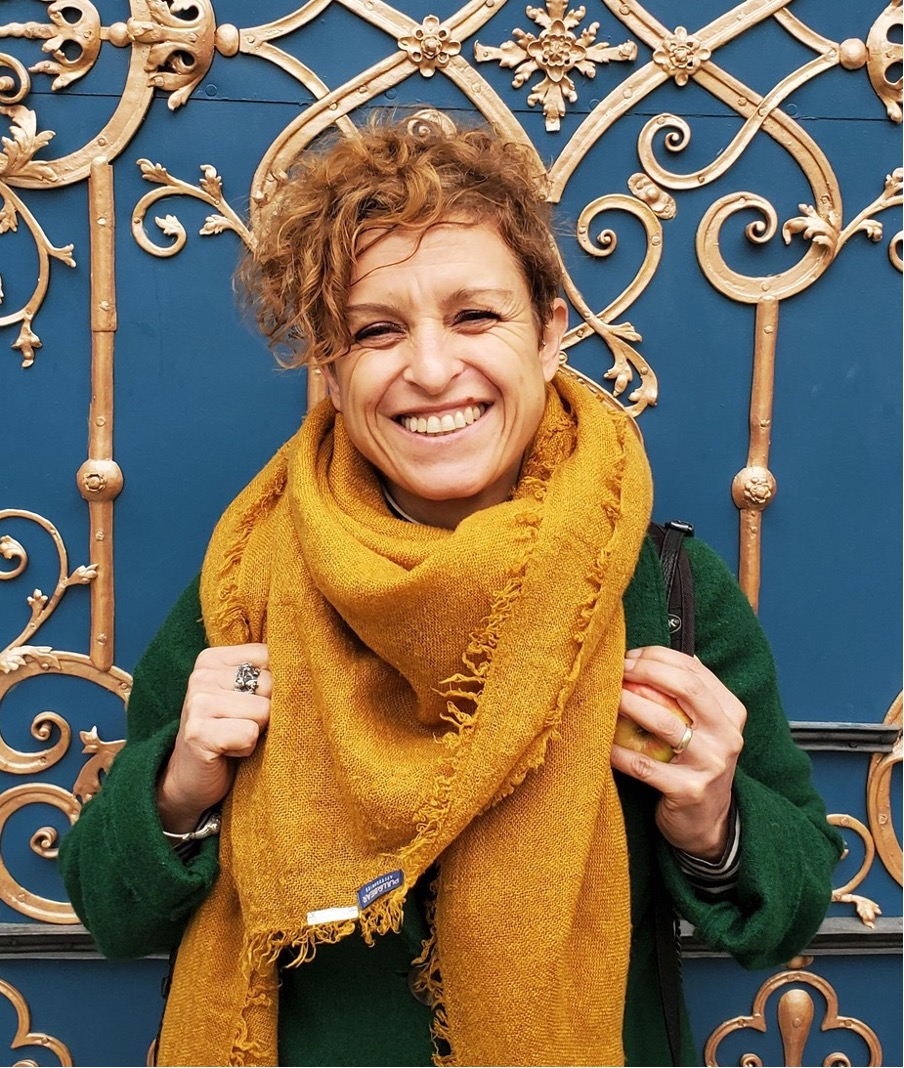
Fabiola Mancinelli, University of Barcelona
Dr. Fabiola Mancinelli, an Assistant Professor at the University of Barcelona, is a social anthropologist specializing in mobilities and tourism. She recently spoke with Azad Heydarov about her work. She moved to Barcelona in 2006 from Italy with a tour-guiding job and a passion for anthropology, a combination that eventually evolved into an MA thesis and later lead her to pursue her PhD studies. Fast forward twenty years, her interest in travel culture remains her guiding research theme. Her research trajectory has explored phenomenological approaches to travel culture, the relationship between tourism and heritage in a postcolonial context, and, more recently, digital nomads. She has conducted extensive fieldwork on these diverse topics in Madagascar, Thailand, and Mediterranean Europe. Her work on digital nomads highlights the convergence of lifestyle mobility and remote working practices, which she investigates through a “mobile virtual ethnography” approach, combining conventional fieldwork with netnography. Among her most recent publications: 2024, “Moving with and against the state: digital nomads and frictional mobility regimes,” Mobilities (with Jennie Germann Molz); 2023, Understanding Neo-nomadic Mobilities beyond Self-Actualization. Mobilities Humanities (with Noel B. Salazar); 2022, “Lifestyle Migrations in the Asia Pacific: A Socio-Anthropological Review.” Monash University. Report; 2020, “Digital nomads: freedom, responsibility and the neoliberal order,” Information Technology and Tourism. Other than in English, she has also published academic articles and chapters on different topics in Spanish, French, and Catalan. From 2018 to 2022, she served as co-convenor of ANTHROMOB, the EASA network of Anthropology and Mobility.
Azad Heydarov has been researching digital nomadism since 2019 for his Ph.D. at the University of Wroclaw and is currently preparing the monograph “Sufferings of Digital Nomadism.” His previous documentary film works examined the attitudes of European youth, which informs his current studies. Azad’s MA thesis explored the motivations behind voluntarism in the context of the European Solidarity Corps. He actively engages with the Lifestyle Migration Hub and is a member of the European Sociological Association (RN30) and the Polish Sociological Association’s Wroclaw Branch.
AH: In the context of digital nomadism, can the concepts of lifestyle migration and lifestyle mobilities be used interchangeably? How do these terms capture the nuances of this contemporary form of mobility?
FM: There are certainly debates and tensions surrounding the terminology to be used to describe certain emerging phenomena. I argue that the terminology we use depends on which end of the movement we are looking at. If we look at digital nomads from a destination perspective, we are more likely to talk about migration because we look at people in their landing pad and the political consequences of their presence. At the same time, we tend to talk about lifestyle mobilities when we focus on the individuals’ trajectories. So, there is no straight answer to your question, as the interchangeability of these terms is both yes and no. For example, in a report I wrote on lifestyle migration in the Asia Pacific, where it originated, I draw on the seminal works of Michela Benson and Karen O’Reilly and defend the use of the term “migration”, although I also explain dedicate a section to differentiate the term from “lifestyle mobilities.” In their curated volume of 2014, Michela Benson and Nick Osbaldiston argue that, in certain contexts using the word migration to describe certain forms of lifestyle-induced relocations is a political choice. I agree with that. Then, we must always be aware that there is always a paradox inherent to the use of conceptual categories: researchers need them to identify phenomena and talk about them, but people’s perceptions and experiences often exceed easy categorization, either because they occupy multiple categories simultaneously or because they would not necessarily self-identify with the categories used in academia.
AH: Considering the unprecedented changes brought about by the COVID-19 pandemic, I would be interested in hearing your insights on its influence on tourism and travel culture. How do you perceive the pandemic has reshaped these sectors, and in your view, what emergent research questions have surfaced as we navigate this new landscape?
FM: Before COVID-19, massification and overcrowding posed major challenges to many popular tourist destinations worldwide. Tourism had transitioned from being an opportunity to becoming a significant problem, reaching a critical tipping point. While I won’t delve into this specific issue, as I was already studying digital nomads at the time, my attention was drawn by the normalization of remote work induced by the restrictions imposed to manage the pandemic’s spread. Traditionally, sociologists and anthropologists have defined tourism as an extraordinary experience: people go on vacation to experience something different from the ordinary nine-to-five routine imposed by the Fordist industrial model’s 40-hour workweek. Therefore, from an anthropological perspective, the blurring boundary between work and leisure, among other things that have happened as a consequence of that time, holds particular novelty. Again, remote work was not entirely new, but its newfound social acceptance allowed for it to extend to many typologies of workers. Businesses and institutions, compelled to operate from workers’ homes, discovered that many white-collar jobs can be effectively performed remotely. This shift has also influenced how people access various services; for example, online sports classes, therapy sessions, or consultations with nutritionists have become more commonplace. This circumstance has boosted the economic opportunities of the online economy. While none of these practices were completely new, the fact that distance-based relationships became so widely accepted carries significant implications, both economically and socially, and for the future of work and tourism.
AH: Given the intricate exploration of digital nomads navigating the dual forces in your paper, “Moving with and against the state: digital nomads and frictional mobility regimes,” could you elaborate on the concept of “border artistry” and its enactment by both individuals and governments?
FM: This finding was particularly intriguing to us when I began collaborating with Jennie Germann Molz on the paper you mentioned (2023). In our previous individual research, we discovered that digital nomads exhibit a strong sense of individualism, driven by a strategic rationale to maximize the benefits of their passports through a practice known as geoarbitrage—relocating to places that offer a more affordable lifestyle. This strategy, together with others they use – such as visa runs, or getting a second passport- we call “border artistry”, a concept introduced by Ulrick Beck. As a whole, “border artistry” refers to how digital nomads leverage their relative privilege to navigate and mitigate the restrictions imposed by borders and migration laws. Interestingly, during the pandemic, numerous countries introduced special visa programs specifically designed to attract digital nomads. Not all of them were labeled as “digital nomads’ visas.” Some used words like “remote work visa” or “work away visa.” Nevertheless, the specific terminology was less significant to us than understanding the underlying trends. We realized that states also practice a kind of “border artistry”. They strategically manipulate border regimes and restrictions to distinguish between desirable and undesirable migrants. One example of this is the “golden visa,” a form of citizenship obtained through investment. However, it’s important to acknowledge that the assumption behind this state-driven “border artistry” is often rooted in classism and sometimes racial biases, primarily based on income considerations.
Research indicates that this practice is not entirely new. In Asian countries like Malaysia, the Philippines, and Indonesia, special visa programs targeting high-income visitors were initiated as early as the 1990s. Reflecting on similar political practices across different geographical contexts was thought-provoking. Despite having stringent migration laws, European countries are simultaneously creating special pathways to facilitate the entry of highly skilled, high-income individuals. This logic illustrates with even more strength the selective and exclusionary nature of mobility regimes, because it views it through the lens of relative privilege. Nation-states adopting neoliberal practices is not groundbreaking. However, seeing how these neoliberal practices unfold on the ground through the creation of special visa programs was enlightening. Thus, the notion of “border artistry” encompasses the strategies employed to sidestep restrictions or challenge established norms, from both the individuals’ and the states’ perspective.
AH: Considering the complex nature of digital nomadism with its ongoing mobility, could you discuss the methodologies used to study this fluid and diverse group? How did you gather data on this mobile population across various locations?
FM: The challenge we faced was thinking research techniques outside the box and going beyond conventional in-person fieldwork. Our approach to “studying up” in relation to public policies was a relatively new endeavor for us. We embraced a hybrid approach, which Jennie Germann Molz refers to as “mobile virtual ethnography.” This method combines online ethnography, interviews, traditional fieldwork, and policy text analysis. However, online ethnography presents certain limitations. I was particularly concerned with the ethical implications of lurking into online communities that is observing without interacting on a daily basis. It was crucial to critically reflect on our methodological choices to ensure their validity. Additionally, we aimed to establish a scalable research protocol that could be replicated by other researchers. Another challenge we encountered was related to self-representation. Unlike traditional fieldwork, where we can observe people in their daily lives to uncover discrepancies between their actions and their discourses, online observations often present us with curated versions of identity. Therefore, filtering or questioning celebratory self-narratives shared on social media became essential, highlighting the need to complement online observations with conventional fieldwork. A third challenge was how to capture floating populations, particularly relevant when examining the impacts on housing markets in leading European cities like Lisbon or Barcelona, now hotspots for digital nomads. Determining the number of digital nomads and researching this transient population posed methodological challenges that remain open for exploration. Research on digital nomads is still unexplored from a destination perspective. I am sure there is a great diversity to be found there, in both scope and scale of the consequences for receiving destinations. Digital nomads in Chiang Mai may differ significantly from those encountered in Barcelona, underscoring the need for further research. In sum, there is still a lot to understand when it comes to digital nomads and how remote work will affect the future of work and tourism.
AH: From your observations, is digital nomadism typically a transitory phase or a longer-term lifestyle?
FM: Considering the trajectories of my research participants, digital nomadism appeared as a stage in the lifecourse. To provide a working definition, digital nomads are online working professionals travel the world, residing in various locations for differing durations of time. I argue, however, that they are a heterogeneous population. Although the term has gathered buzz in popular media, it serves as an umbrella descriptor encompassing a spectrum of diverse combinations of remote work and travel. However, from what I have observed, people do not sustain an ongoing mobile lifestyle indefinitely; rather, it is something they adopt for a specific phase within their life course. Therefore, while a life course perspective is crucial, individual experiences may vary. People can become digital nomads at the beginning of their professional careers when they are uncertain about the future or want to bootstrap a business idea or learn a particular skill. Others transition to this lifestyle later in life, desiring a change from their professional routine. In certain cases, individuals eventually establish a more permanent residence and transition to expatriate status after a period of time.
Digital nomadism can also be understood as a quest for an ideal place to live. Similar to lifestyle migration, it reflects a pursuit of a good life. For digital nomads, this often involves seeking the ideal living environment, sometimes intertwined with investment strategies. At some point, people may acquire property as a home base, although in many cases, it serves as an investment for passive income. This decision can also be influenced by the desire to have a family. Alternatively, factors such as burnout, lack of community, constant mobility, uncertainty, or absence of a fixed abode may prompt a shift towards a more “rooted” lifestyle. So, do digital nomads eventually become expatriates? In all likelihood, yes. While some may return to their place of origin, the majority tend to relocate elsewhere. In this regard, digital nomadism often serves as an entry point to lifestyle migration.
 The Lifestyle Migration Hub Blog